A Map, a Name, and an Unexpected Comeback: How MapQuest Turned Google’s Lake Ontario Decision Into an Opportunity
A Map, a Name, and an Unexpected Comeback: How MapQuest Turned Google’s Lake Ontario Decision Into an Opportunity
For years, MapQuest was remembered primarily as the website people used to print driving directions before leaving home. Google Maps, Apple Maps, and Waze eventually transformed navigation into a real-time, mobile experience, pushing MapQuest out of the spotlight.
Then Lake Ontario unexpectedly gave the pioneering navigation company another turn in the public eye.
Two Companies, Two Different Decisions
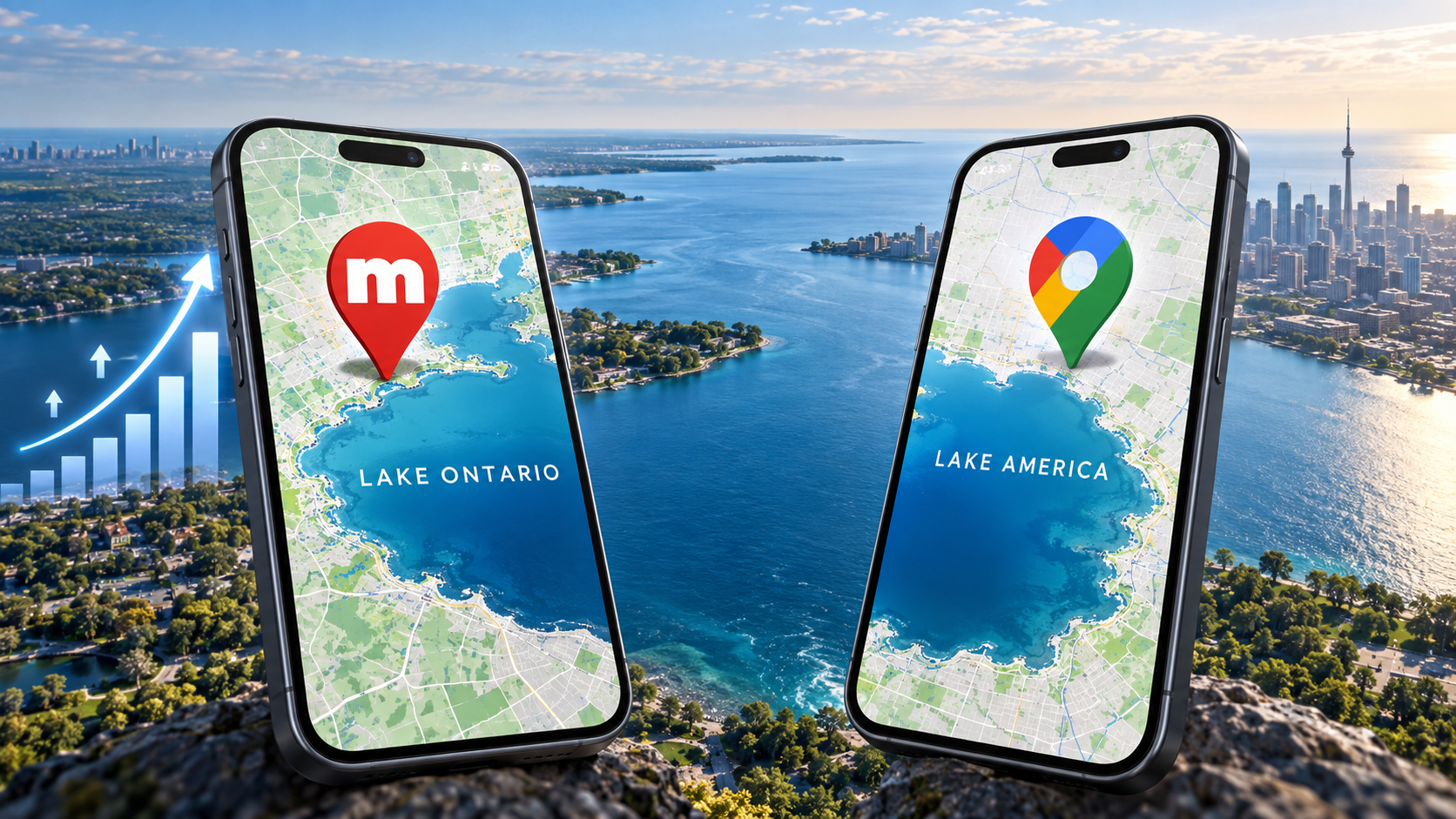
Following a federal decision to rename Lake Ontario as “Lake America,” Google updated Google Maps to reflect the new federal designation for users in the United States. Canadian users continue to see “Lake Ontario,” while users outside the United States and Canada see both names.
Google explained that it routinely relies on official government sources when determining which geographic names appear on its maps. In the United States, that source is the Geographic Names Information System. From Google’s perspective, the update represented the application of an existing data-management policy rather than the creation of a new political position. Google’s official explanation outlines how the name appears differently based on a user’s location.
MapQuest made a different choice. The company announced that it would continue displaying “Lake Ontario,” emphasizing its preference for familiar and historically recognized geographic names. It also offered a lighthearted online tool that allowed people to assign their own names to the lake.
Both companies could therefore claim consistency. Google remained consistent with its policy of following federal geographic databases, while MapQuest remained consistent with its position that maps should preserve the names users already recognize.
The difference was how customers interpreted those decisions.
How MapQuest Regained Public Attention
MapQuest’s short declaration—“We’re not changing it”—quickly became more than a statement about a map label. For many users, it represented independence, familiarity, and resistance to allowing political changes to immediately reshape everyday digital tools.
The response was significant. By August 30, MapQuest reported becoming the number-one navigation app in Apple’s U.S. App Store and the eighth-ranked free app overall. It also reached the number-two overall position in Canada. The company said hundreds of thousands of people downloaded its apps and that usage increased to approximately 50 times its normal level. These were the strongest app-store results in the company’s 30-year history. MapQuest’s company announcement described the surge as a response to its decision to retain familiar geographic names.
Several factors helped MapQuest gain traction.
First, the company delivered a simple and memorable message. It did not release a complicated policy statement. It communicated a clear decision that people could immediately understand and share.
Second, MapQuest benefited from nostalgia. Millions of people remember using the service during the early years of online mapping. The controversy reminded consumers that MapQuest still existed and gave former users a reason to try it again.
Third, the decision created differentiation. Navigation apps generally compete through similar features, including traffic information, route planning, and voice guidance. MapQuest briefly changed the basis of competition from technology to identity and values.
Finally, downloading a free navigation app required little commitment. People who supported MapQuest’s position could express that support immediately, producing visible movement in app-store rankings.
The Challenge: Turning Attention Into Retention
A download spike is not the same as a sustainable comeback. Users may initially install MapQuest because of the Lake Ontario decision, but they will continue using it only if the app performs reliably during everyday travel.
MapQuest has already made meaningful improvements. Its current app includes voice navigation, real-time traffic, alternate routes, multipoint trip planning, CarPlay support, lane guidance, speed-limit information, traffic-camera warnings, and saved-place collections. Its September 2026 update also introduced beta reporting for crashes, road closures, police activity, and other incidents. The MapQuest App Store listing shows that the company is actively updating the product.
However, recent user feedback also identifies areas requiring improvement. Some users report questionable route choices, an excessive preference for major highways, and insufficient guidance about whether a destination will be on the right or left side of the road.
If MapQuest wants to convert this moment into long-term growth, it should concentrate on the following upgrades.
What MapQuest Should Improve
1. Make routing accuracy the highest priority
Navigation users will forgive an outdated design before they forgive an inaccurate route. MapQuest should strengthen local-road data, construction updates, address placement, and real-time rerouting. It should also explain why it recommends a route—for example, fastest, simplest, least congested, or most fuel-efficient.
The arrival experience should clearly identify the correct side of the road, building entrance, parking location, and final walking direction.
2. Complete its community-reporting system
MapQuest’s new incident-reporting feature is an important step toward competing with Waze. The company should quickly add verified alerts from other drivers, hands-free voice reporting, automatic expiration of outdated reports, and visible confirmation when multiple users verify an incident.
Community participation could become one of the app’s strongest retention tools.
3. Add dependable offline navigation
Users need navigation during road trips, mountain travel, emergencies, and visits to areas with poor cellular coverage. Downloadable regional maps, offline address searches, and offline rerouting would give MapQuest a valuable practical advantage.
4. Give users more control over rerouting
Some navigation apps automatically switch routes even after a driver deliberately selects another option. MapQuest could distinguish itself by offering a “keep my selected route” setting and requesting permission before making major route changes.
Users should also be able to establish preferences such as avoiding difficult intersections, unpaved roads, steep grades, tolls, school zones, or complicated highway merges.
5. Become the privacy-conscious navigation alternative
MapQuest should publish a simple explanation of what location data it collects, how long it retains that information, and whether it is used for advertising. It could offer private-navigation and automatic trip-deletion settings prominently within the app.
A low-cost, advertisement-free subscription could also appeal to people who want a cleaner experience and greater privacy.
6. Expand transportation and accessibility options
To compete more broadly, MapQuest should improve walking, cycling, public-transit, motorcycle, commercial-vehicle, and accessibility-focused navigation. Users should be able to search for wheelchair-accessible entrances, accessible parking, well-lit walking routes, and locations with appropriate facilities.
7. Introduce AI only where it improves safety and simplicity
MapQuest does not need to overwhelm the app with artificial intelligence. It could use conversational voice commands to help drivers safely request a gas station, restaurant, hotel, charging station, or alternate route without touching the screen.
The goal should be fewer distractions—not more notifications.
8. Listen visibly to its new users
MapQuest should invite its recent users to participate in short surveys, beta-testing groups, and feature votes. It should then publish a visible product roadmap showing which improvements are planned, underway, or completed.
That would turn a one-time political and cultural moment into an ongoing customer relationship.
MapQuest’s Second Chance
The Lake Ontario controversy did not suddenly give MapQuest better technology than Google Maps, Apple Maps, or Waze. It gave the company something nearly as valuable: renewed relevance.
Google followed an established government-data policy. MapQuest made a brand decision centered on historical familiarity. The market response demonstrated that mapping services are not viewed only as neutral utilities. People also care about how technology companies interpret authority, history, culture, and customer expectations.
MapQuest now has an opportunity that most legacy technology brands never receive—a genuine second chance. Its public position brought people through the door. Product quality, transparent communication, routing accuracy, privacy, and continuous innovation will determine whether they stay.
If MapQuest moves quickly while preserving the simplicity that made its message successful, the Lake Ontario decision could become more than a temporary surge. It could mark the beginning of one of the technology industry’s most unexpected comebacks.